
How Your Income Today Sets Your Medicare Premium Two Years From Now
Medicare open enrollment runs from October 15 through December 7. Most of the attention during those weeks goes to plan selection, drug coverage, and provider networks.
The more consequential number is not on the enrollment form at all. It was determined two years ago, by a tax return that has already been filed.
Higher-income Medicare beneficiaries pay a surcharge on Part B and Part D premiums called the income-related monthly adjustment amount, or IRMAA. It is calculated on modified adjusted gross income from the tax year two years before the premium year. The Social Security Administration requests that data from the IRS because a return from two years prior is usually the most recent one available. (Source: Social Security Administration, Program Operations Manual System HI 01101.030, IRMAA Determination Process.)
For 2026 premiums, that means the 2024 return. For 2028 premiums, it means the return you are shaping right now.
Quick links
What are the 2026 IRMAA brackets?
The standard Part B premium in 2026 is $202.90 per month, up from $185.00 in 2025. The annual Part B deductible is $283. (Source: Centers for Medicare & Medicaid Services, 2026 Medicare Parts A & B Premiums and Deductibles, November 14, 2025.)
Above the first threshold, a surcharge applies. The full 2026 Part B schedule, from the same source:
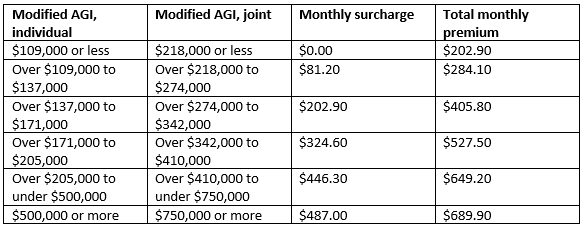
Part D carries its own surcharge on top of the plan premium, running from $14.50 per month at the first tier to $91.00 per month at the highest. (Same source.)
Married beneficiaries filing separately are on a separate schedule. Those at $109,000 or less pay the standard premium, those above $109,000 and under $391,000 pay $284.10, and those at $391,000 or more pay $405.80.
Why does one dollar of income matter so much?
Because these are thresholds, not a sliding scale.
An individual whose modified adjusted gross income lands at $109,000 pays $202.90 per month for Part B. An individual at $109,001 pays $284.10. The additional dollar of income costs $81.20 per month on Part B and another $14.50 on Part D, roughly $1,148 over a full year.
For a married couple where both spouses are enrolled, the surcharge applies to each of them. The same threshold crossing costs the household roughly $2,296.
That is the structure that makes fourth-quarter income decisions worth modeling. A Roth conversion, a large realized gain, or the sale of a property can move a household across a line it did not know was there, and the consequence does not appear for two years.
What is modified adjusted gross income for IRMAA purposes?
Modified adjusted gross income for this calculation is adjusted gross income, found on line 11 of Form 1040, plus certain tax-exempt income. (Source: Social Security Administration, Program Operations Manual System HI 01101.010, Modified Adjusted Gross Income.)
The inclusion of tax-exempt interest is the detail that surprises people most often. Municipal bond income that produces no federal income tax still counts toward the IRMAA calculation. A portfolio built deliberately for tax efficiency can still push a household into a higher Medicare bracket.
What if income dropped after the year being measured?
The two-year lookback creates an obvious problem: someone who retires sees their income fall, but their Medicare premium is still calculated on the higher income they earned while working.
Social Security provides a process for this. A beneficiary who has experienced a qualifying life-changing event can request a new initial determination, using Form SSA-44, so that the premium is based on more recent income rather than the two-year-old return.
Qualifying events are specific rather than general. They include work stoppage or reduction, marriage, divorce or annulment, the death of a spouse, loss of income-producing property, loss of pension income, and receipt of an employer settlement payment. (Source: Social Security Administration, Form SSA-44, Medicare Income-Related Monthly Adjustment Amount, Life-Changing Event.)
A one-time spike in income from a Roth conversion or a large capital gain is not on that list. That is worth saying plainly, because it is the assumption families most often make. A voluntary decision to recognize income is not treated as a life-changing event, and the resulting surcharge generally stands.
Why does this belong in the conversion conversation?
Because a conversion analysis that stops at the marginal tax rate is incomplete.
The full cost of a conversion includes the income tax on the converted amount, any effect on the taxation of Social Security benefits, any exposure to the net investment income tax, and the Medicare surcharge two years forward. A conversion can still be the right decision with all of those included. Many are. But the decision should be made against the whole number, not a piece of it.
The practical implication is a sequencing one. The Medicare threshold check belongs in the same conversation as the conversion sizing, not in a separate meeting two years later when the premium notice arrives.
This is also why the conversation is worth having in October rather than December. Modeling a conversion against multiple thresholds takes time, and the alternative of converting a smaller amount across several years only works if the multi-year view is built before the first conversion happens.
For related context, see our September 2026 blog: Roth Conversion Strategies: Why the Window Before Year-End Matters.
Implementation checklist for Medicare and income coordination
Confirm which IRMAA bracket your projected current-year income is tracking toward
Include tax-exempt interest in that projection, because it counts
Before converting, model whether the conversion crosses a threshold
Evaluate whether spreading a conversion across multiple years keeps you under a line
If a qualifying life-changing event occurred, review Form SSA-44
Remember the two-year lag when reviewing a premium increase you did not expect
Review your open enrollment plan selection between October 15 and December 7
FAQs
Which year's income determines my 2026 Medicare premium?
Your 2024 return. The Social Security Administration uses income data from the tax year two years before the premium year. (Source: Social Security Administration, POMS HI 01101.030.)
Does tax-exempt municipal bond interest count toward IRMAA?
Yes. The calculation is adjusted gross income plus certain tax-exempt income, so municipal interest that produces no federal income tax still counts toward the threshold.
Can I appeal an IRMAA surcharge caused by a Roth conversion?
Generally no. The life-changing event process is designed for events such as retirement, marital changes, or loss of pension income. A voluntary decision to recognize income is not among the qualifying events.
How much does crossing the first threshold actually cost?
In 2026, an individual crossing the first Part B threshold pays $81.20 more per month, plus $14.50 more per month on Part D, roughly $1,148 over the year. A married couple where both are enrolled pays that twice.
Review your income before the year closes
Download the Q4 Income Checklist: 12 decisions that set your 2026 tax bill and your 2028 Medicare premium.
Download the checklist: https://lp.constantcontactpages.com/sl/xGspWYv/Q4IncomeChecklist
Subscribe to the Bellwether Briefing: https://www.bellwetherwealth.com/newsletter
Bellwether Wealth does not provide tax or legal advice. This material is provided for general informational and educational purposes only and should not be construed as individualized tax, legal, or investment advice. Tax laws and regulations are complex and subject to change, and their application depends on an individual's specific facts and circumstances. Before implementing any tax, retirement, charitable giving, estate planning, or other strategy discussed, consult with your CPA, tax professional, attorney, and/or other qualified professional regarding your individual circumstances. Advisory services offered through Bellwether Wealth, an SEC-registered investment adviser.